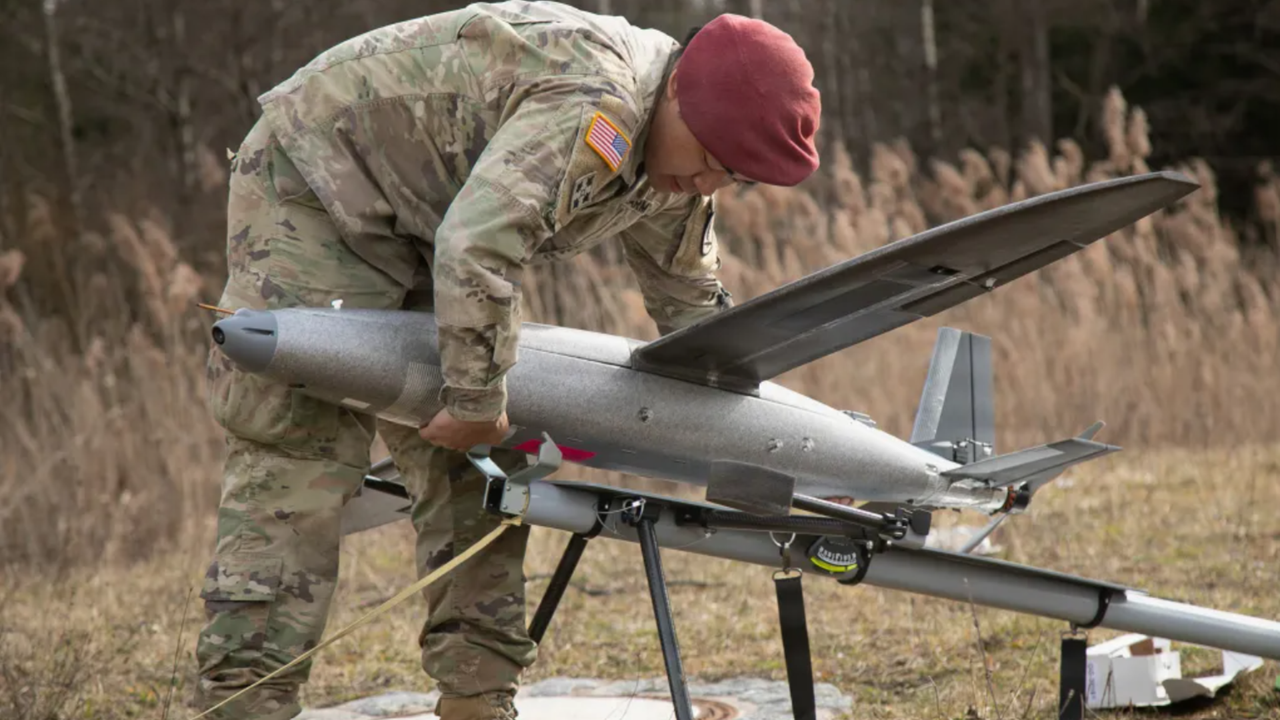
'A masterclass in sensor-to-shooter kill chain management': Blackhawk Company commander explains what he learned from controversial US-Ukraine 'drone-first' wargame
Ukrainian drones forced American soldiers to rethink movement, concealment, and battlefield survival Blackhawk troops changed their tactics after persistent aerial surveillance exposed their movements American armored vehicles suffered losses despite attempts to conceal them from drones A 10-day US
<![CDATA[ <article> <ul><li><strong>Ukrainian drones forced American soldiers to rethink movement, concealment, and battlefield survival</strong></li><li><strong>Blackhawk troops changed their tactics after persistent aerial surveillance exposed their movements</strong></li><li><strong>American armored vehicles suffered losses despite attempts to conceal them from drones</strong></li></ul><p>A 10-day US Army combat training exercise in Germany has drawn attention after reports claimed Ukrainian drones overwhelmed an American mechanized company during the drill.</p><p>At the center of it is Blackhawk Company, part of the 2nd Battalion, 7th Cavalry Regiment, which spent the ten days training at a range in Hohenfels.</p><p>The company commander, Capt. Allan Watson, disputes that account, insisting the report failed to capture what his soldiers actually accomplished over those days.</p><h2 id="entering-a-battlefield-dominated-by-drones">Entering a battlefield dominated by drones</h2><p>Blackhawk Company entered a 14-by-27-kilometer range where Ukrainian personnel from the 412th Regiment supported opposing forces during initial operations.</p><p>The Ukrainian elite formation, called Nemesis, had battlefield experience and used aerial systems to observe American movements across the range.</p><p>The American unit claims to lack the counter-drone equipment its soldiers would have preferred throughout the event.</p><p>Rather than relying on unavailable equipment, soldiers altered how they occupied positions, moved vehicles, and concealed personnel from aerial observation.</p><p>Bradley vehicles moved beneath dense vegetation, while troops used steep ground and difficult routes to reduce their exposure from above.</p><p>The company also studied its movements from an aerial perspective, changing routines that might have made detection easier for enemy operators.</p><p>Despite those changes, American vehicles were destroyed during simulated combat, including Bradley vehicles plus tanks, while some crews were also counted as losses.</p><p>Watson, however, rejected the idea that these losses proved heavy armor had become unsuitable for modern combat environments.</p><p>He said armored vehicles remained useful because they provided mobility and protection while allowing soldiers to move through difficult terrain during operations.</p><h2 id="adapting-tactics-changed-the-exercise">Adapting tactics changed the exercise</h2><p>The commander said <a href="https://www.techradar.com/cameras/drones/best-drone">drones</a> could locate American forces, but exploiting that information still required personnel operating at ground level.</p><p>That distinction became important as the exercise progressed, because Ukrainian aerial surveillance did not remove the need for conventional reconnaissance.</p><p>On the sixth day, Blackhawk Company shifted from defensive tasks toward offensive operations, while the Ukrainian formation later operated alongside American troops.</p><p>Watson said the soldiers became increasingly confident as they adjusted to conditions that challenged assumptions formed through earlier training.</p><p>The Ukrainian participants also shared methods for operating inexpensive drones over long distances and linking battlefield observation with rapid engagement.</p><p>“They put on a masterclass in sensor-to-shooter kill chain management and speed,” said Capt. Allan Watson, Blackhawk Company commander.</p><p>Watson also said the experience showed that technology alone does not determine battlefield outcomes, because human decisions remain essential during combat.</p><p>For Watson, the principal lesson was not that drones had replaced armored formations, but that units must adjust tactics when aerial surveillance becomes persistent.</p><p>However, this is also not the first US military exercise where <a href="https://www.techradar.com/pro/ukrainian-drones-disabled-us-armor-brigade-in-simulated-warfare-so-quickly-that-they-had-to-respawn-the-equipment">Ukrainian drone teams have caught American forces off guard</a>.</p><p>In an earlier exercise in Germany, US troops were defeated so quickly that exercise officials allowed those units to re-enter the scenario.</p><p>These events were designed to expose weaknesses, test countermeasures, and help American forces prepare for drone-heavy warfare.</p><p>Ukraine’s experience against Russia has made its drone units especially capable in unmanned systems and electronic warfare operations.</p><p>The repeated setbacks, therefore, raise a more direct question about whether US forces should adapt more quickly and improve their capabilities.</p><p>Rather than explaining away each defeat as a training outcome, American forces need to treat these exercises as warnings. </p><p>Via <a href="https://taskandpurpose.com/opinion/op-ed-ukraine-drone-commander/" target="_blank" rel="nofollow">Task&Purpose</a></p><figure class="van-image-figure inline-layout" data-bordeaux-image-check ><div class='image-full-width-wrapper'><div class='image-widthsetter' style="max-width:676px;"><p class="vanilla-image-block" style="padding-top:31.51%;"><img id="diM9tpwF2Lz85R8q85CT78" name="tr-g_news" alt="Google logo on a black background next to text reading 'Click to follow TechRadar'" src="https://cdn.mos.cms.futurecdn.net/diM9tpwF2Lz85R8q85CT78.jpg" mos="" align="middle" fullscreen="" width="676" height="213" attribution="" endorsement="" class="inline"></p></div></div></figure> </article> ]]>
Read the full article on TechRadar
Read Full Article →